Issued: June 2026
This advisory shares information passed to us by our driver-guides on the ground regarding ongoing controlled burning in the Serengeti National Park, supported by the published positions of the Tanzania National Parks Authority (TANAPA), the Mara Conservancy Management Plan, and the Uganda Wildlife Authority (UWA).
It explains what controlled burning is, why it is carried out, how widely the practice is used across East Africa, and what it means for guests in the parks during the burning season.
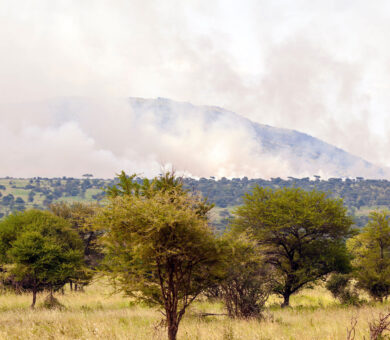
Controlled, or “prescribed”, burning is currently taking place in sections of the Serengeti. This is part of the government’s established conservation and land-management programme, managed by the Tanzania National Parks Authority under Serengeti National Park Management.
The burns aim to stimulate fresh, nutrient-rich grass for wildlife, prevent bush encroachment, and reduce the risk of larger, uncontrolled dry-season wildfires.
They are typically carried out between roughly June and September, shortly after the wet season, when conditions are most suitable for managing vegetation.
Burning is conducted by TANAPA in designated sections over a period of time, rather than across the whole park at once, and rangers monitor the fires to prevent them spreading.
Controlled burning is not unique to the Serengeti. It is a long-established management tool used across the wider East African savanna and the shared Serengeti–Mara ecosystem.
Because the Serengeti and the Maasai Mara form a single connected ecosystem, guests travelling in either country during the dry season may encounter the same practice. Rotational, sectional burning is considered normal seasonal management rather than an emergency event.
While these burns play an important role in conservation, they can be concerning for safari guests, particularly when changing wind conditions carry smoke towards camps and lodges.
We suggest setting expectations with travelling guests ahead of the June to September period. Controlled burning is a normal, beneficial part of how these parks are managed, short-notice relocation is rarely feasible, and any visible smoke or fire is being managed by the park authority.
The extensive road network means game-viewing typically continues in unburned sections, and the fresh regrowth that follows a burn is itself a strong draw for wildlife.
Our team is always available to advise on specific bookings.
Tanzania National Parks Authority, Serengeti National Park Management, Mara Conservancy Management Plan, Uganda Wildlife Authority, published savanna fire ecology research, and ground-level reports from ARP driver-guides at time of issue.
Prepared by ARP Africa Travel Group.